
LaLiga's Fan-Service Breach Shows Why Shared Platforms Need Clear Ownership
Key Facts
- An unpatched vulnerability exposed email addresses of several hundred people and personal information about a small number of individuals subject to stadium bans.
- On November 16, LaLiga's security team identified the source of unauthorized access and implemented measures to block the attack and stop data extraction.
- The league said no other LaLiga systems were impacted; Real Oviedo and Real Zaragoza said their infrastructure and databases were unaffected, while Córdoba CF said the platform was operated independently.
- LaLiga stepped up monitoring and reported the incident to the AEPD and the National Police's Central Cybercrime Unit.
- Earlier in 2026, LaLiga partnered with Fastly on AI-based systems for identifying and disrupting illegal sports streams, which it estimated cost its clubs between $700-$800m (€600-€700m) each year.
What happened
LaLiga disclosed a data breach affecting its fan services platform in Spain. A hacker exploited an unpatched vulnerability, exposing the email addresses of several hundred people. The breach also exposed personal information belonging to a small number of individuals subject to stadium bans.
The affected information belonged to users of LaLiga’s services and those of some affiliated clubs. LaLiga, Spain’s top men’s professional football league, said no other LaLiga systems were impacted. The disclosure therefore describes a breach of a fan services platform, not a compromise of every LaLiga system.
On November 16, LaLiga’s security team identified the source of the unauthorized access and implemented measures to block the attack and stop the data extraction. The statement said the data theft was stopped and the attacker blocked that day. November 16 marks the containment action. It should not be read as the date the intrusion began.
What the club responses establish
LaLiga oversees Spain’s two professional football divisions, representing 42 clubs. Its structure matters here because a shared platform can serve users across organizations without sitting inside each organization’s own technology environment.
Real Oviedo and Real Zaragoza said their own technology infrastructure and databases had not been affected. Córdoba CF said the breach involved a platform operated independently of the club. Those answers are narrow. They address local systems or the operator of the affected service; they do not settle whether fans of those clubs used it.
Real Madrid and FC Barcelona have not publicly said whether their fans were affected. That silence is not evidence that fans were exposed, and it is not evidence that they were spared. It leaves the question open.
The disclosure supports a limited conclusion: personal information was exposed for users of LaLiga and some affiliated clubs’ services. It does not establish that all 42 clubs were affected.
Containment, monitoring and reporting
LaLiga stepped up system monitoring and reported the incident to the Spanish Data Protection Agency (AEPD) and the National Police’s Central Cybercrime Unit. Those actions followed the work needed to identify the source and stop the extraction.
The sequence contains three distinct tasks. LaLiga identified where the unauthorized access came from, blocked the attack and stopped data from being taken. Each task answers a different question: the source of the intrusion, the attacker’s ability to continue and the status of the extraction.
For a shared service, the practical lesson is to assign those responsibilities before an incident. Patching ownership matters because the exploited flaw was unpatched. Monitoring matters because unusual access must be detected. Clear decision-making matters because stopping extraction may require action on a platform used by more than one organization.
The account also separates confirmed impact from open questions. The exposure is established, as is the claim that no other LaLiga systems were impacted. The scope among affiliated clubs remains less clear.
Streaming enforcement is a separate issue
Earlier in 2026, LaLiga partnered with Fastly to deploy AI-based systems for identifying and disrupting illegal sports streams, which it estimated costs its clubs between $700-$800m (€600-€700m) each year.
That work concerns illegal distribution of matches. The fan services breach concerns unauthorized access to user information. The two subjects should not be collapsed into a single claim about LaLiga’s security. The streaming partnership does not explain the breach, and the breach does not show that the streaming systems failed.
The financial estimate belongs to the streaming issue. It is not a measure of the cost of the data breach, and LaLiga has not provided such a figure in the account described here.
The broader lesson
A shared platform changes the unit of responsibility. The club statements distinguish local infrastructure, a separately operated platform and a league-wide disclosure. Incident response should keep those layers distinct while coordinating the message to users, clubs, regulators and law enforcement.
That does not require every organization to use the same systems. It requires clear agreements about who maintains the service, who investigates unauthorized access and who can authorize urgent action. It also requires careful language. Saying that a club’s databases were unaffected should not imply that all fan data was safe.
LaLiga’s disclosure is specific. An unpatched flaw was exploited, email addresses and personal information were exposed, extraction was stopped and the attack was blocked on November 16. The response should stay just as specific: acknowledge the exposure, report it through the proper channels and avoid drawing broader conclusions than the facts support.
Sources & References
- Source referenced in coverage https://therecord.media/laliga-hacked-spain-top-professional-league-confirms-cyber-incident

SecurityXP delivers cybersecurity news, vulnerability analysis, data breach reports, and threat intelligence.
Security Digest
The most important cybersecurity stories, CVE alerts, and threat intelligence — one concise email. Unsubscribe anytime.
Related Articles
Bell Canada Confirms "Agentic" Threat Actor Breached Systems and Stole Enterprise Customer Data
Bell Canada says an "agentic" threat actor accessed a pre-production Maximo environment on November 17 and exfiltrated enterprise customer data, but has not attributed the attack.
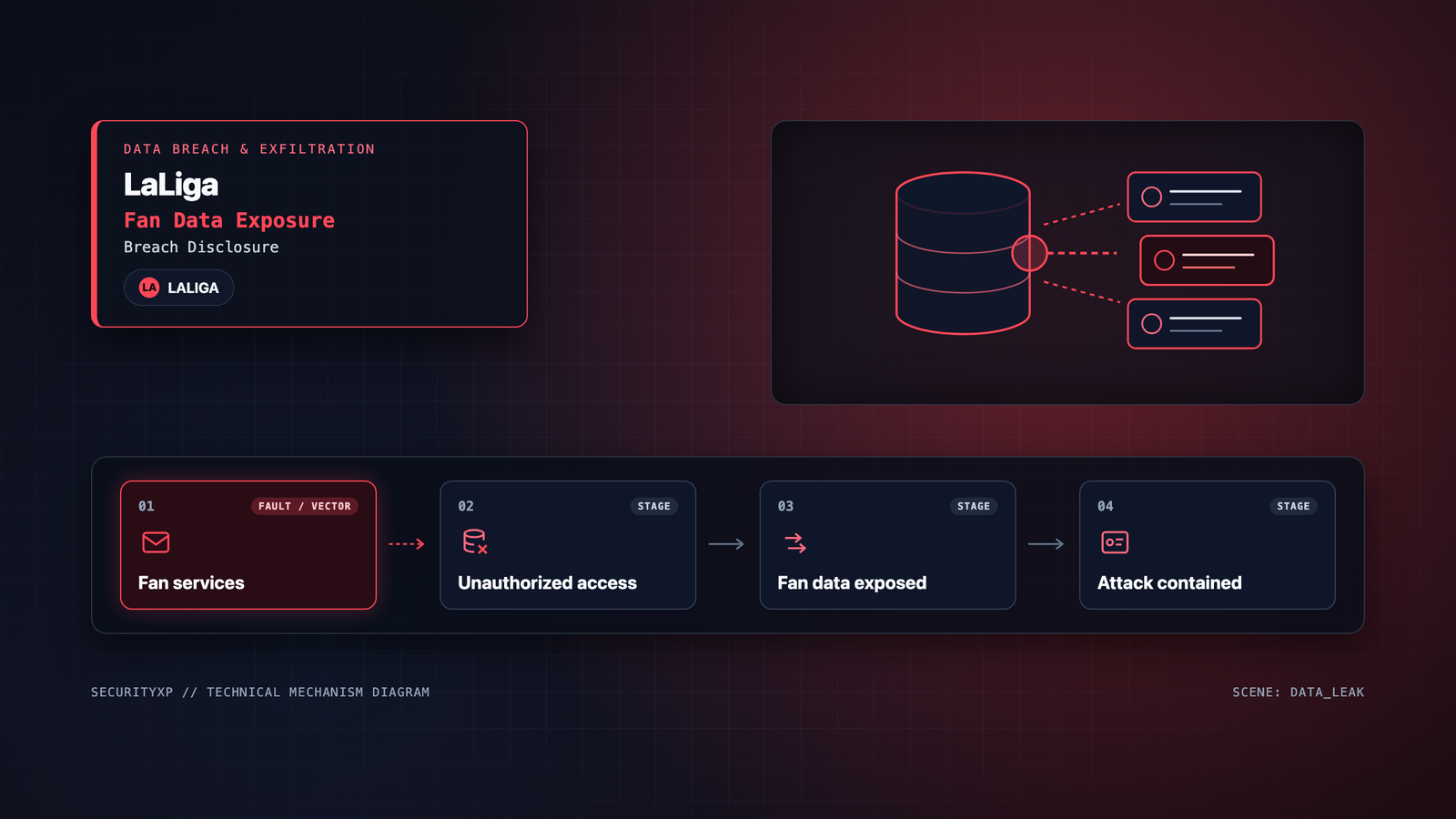
LaLiga Confirms Fan Data Breach Across Club Digital Services
LaLiga says hackers stole personal information from a platform serving fans and several clubs between November 14 and 16; the attack was contained and no other systems were affected.
FBI Criminal Database Breached Again, Second Hack in Months Targets US Crime Records
The FBI's criminal database has been hacked for the second time in months, according to reports from India Today and Hindustan Times.

AI Approval Is Not Access Control: What the 97% Breach Statistic Actually Says
IBM's 2025 Cost of a Data Breach Report found that 97% of organizations reporting an AI-related breach lacked proper AI access controls. Approval is not the same as an access review.