
Rapid7 Details VMware vCenter SRP Authentication Bypass to Root (CVE-2026-123890)
Key Facts
- CVE-2026-123890 is an authentication bypass in the VMware vCenter SRP authentication flow.
- Rapid7 says an unauthenticated attacker can retrieve the session key for an in-progress administrator login.
- The attacker can reuse the session key to complete the login without knowing the account password.
- Successful exploitation can lead to root-level access to the vCenter appliance.
- Rapid7 reproduced the chain on vCenter Server Appliance 8.0.2.00400 without using a second vulnerability after administrative RPC access.
- Broadcom identifies vCenter 8.0 U3m as the fixed release for the 8.0 branch.
Rapid7’s November 24 analysis of CVE-2026-123890 explains how an unauthenticated attacker can complete a VMware vCenter administrator login without knowing the account password. The vulnerable directory-service interface is exposed through DCE/RPC on TCP port 2012.
The flaw combines two failures in the Secure Remote Password (SRP) flow. A session-key getter can be called before authentication, and the RPC context lookup does not verify that the requesting connection owns the context. Rapid7 found that the context handles use predictable UUIDv1 values. By creating reference contexts around a pending login, an attacker can narrow the hidden handle to a short timestamp window and request its key. The attacker initiates the login; an administrator does not need to be online.
Recovering the pending login’s 20-byte session key lets the attacker produce the normal SRP proof and finish authentication without a password. Rapid7 says the resulting administrator connection can use the directory database-copy interface to retrieve data.mdb, which contains the Security Token Service private signing key. That key can be used to forge an administrator API assertion.
Rapid7 reproduced the chain on vCenter Server Appliance 8.0.2.00400. The researchers used the forged API session to create a local superAdmin account, enable SSH and Bash, and execute commands as root through sudo. They report that no second vulnerability was required after obtaining administrative RPC access.
For detection, Rapid7 highlights repeated unauthenticated calls to the SRP helper’s key-retrieval operation, context UUIDs that differ mainly in their timestamp fields, and correlations with unexpected database-transfer grants, local-account creation and SSH or Bash changes. A connection to port 2012 or an administrator login alone is not evidence of exploitation.
Broadcom identifies vCenter 8.0 U3m as the fixed release for the 8.0 branch. Organizations should apply the supported update for their deployed branch and restrict directory-service management interfaces to systems that require them.
Sources & References
- Rapid7 analysis of the VMware vCenter SRP authentication bypass, including session-key retrieval and root access. https://www.rapid7.com/blog/post/ra-rapid7-analysis-vmware-vcenter-srp-authentication-bypass-to-root-cve-2026-123890
- HKCERT bulletin covering VMware product vulnerabilities and remediation. https://www.hkcert.org/security-bulletin/vmware-products-multiple-vulnerabilities_20261123
- Broadcom security advisory for VMware vCenter vulnerabilities, including fixed builds. https://support.broadcom.com/web/ecx/support-content-notification/-/external/content/SecurityAdvisories/0/39495
- CVE-2026-123890 — National Vulnerability Database

SecurityXP delivers cybersecurity news, vulnerability analysis, data breach reports, and threat intelligence.
Security Digest
The most important cybersecurity stories, CVE alerts, and threat intelligence — one concise email. Unsubscribe anytime.
Related Articles
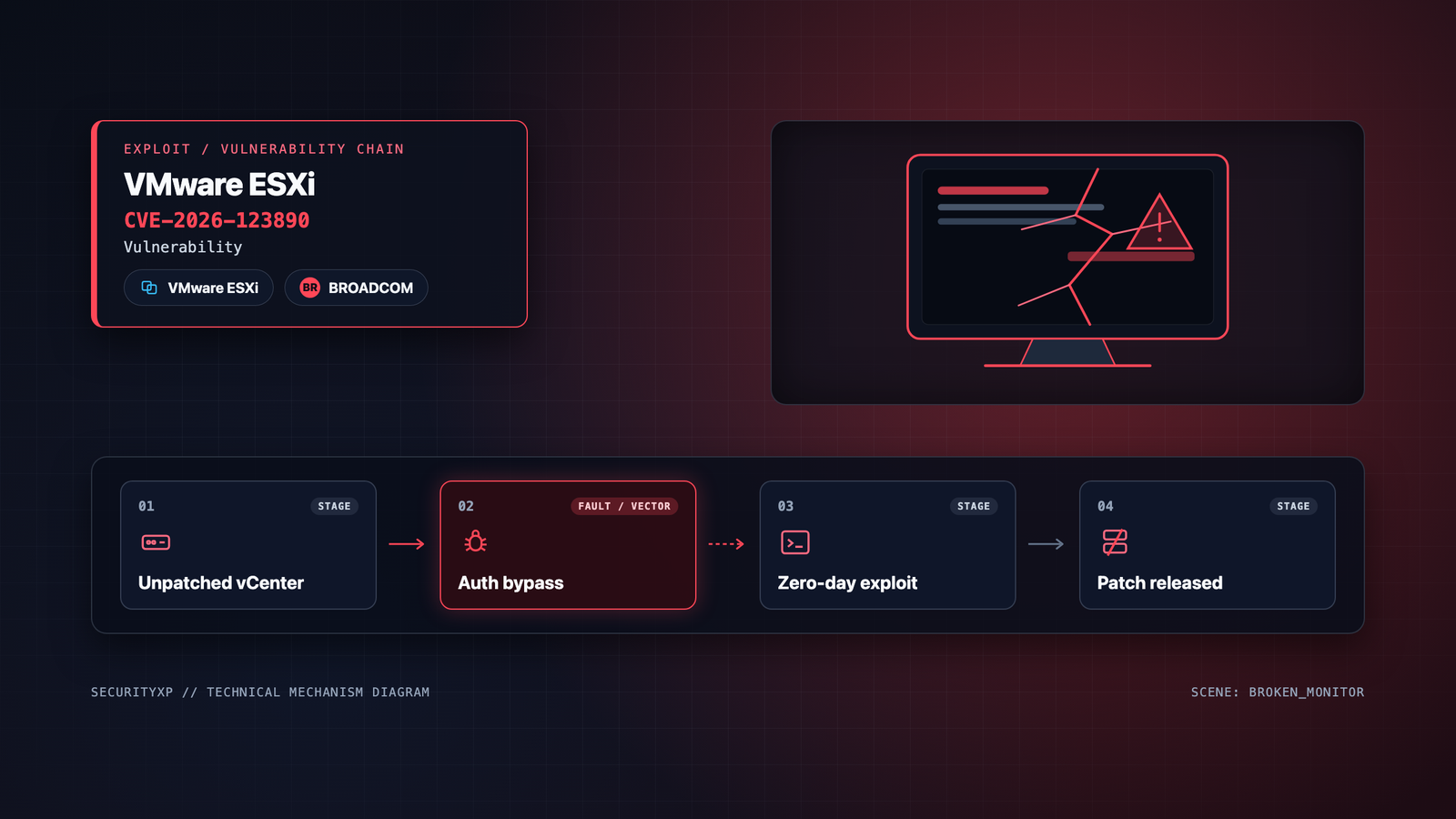
VMware vCenter Authentication Bypass Exploited as Zero-Day for Over Two Months Before Patch
Broadcom's VMSA-2026-0009 fixes CVE-2026-123890, a vCenter authentication bypass exploited as a zero-day. Affected versions, fixed builds and hunting guidance.
CISA Adds Cisco Expressway, SAP NetWeaver, VMware vCenter and Apache Roller Flaws to KEV Catalog
CISA added four vulnerabilities to its Known Exploited Vulnerabilities catalog on November 20 and set a November 23 remediation deadline for federal agencies.
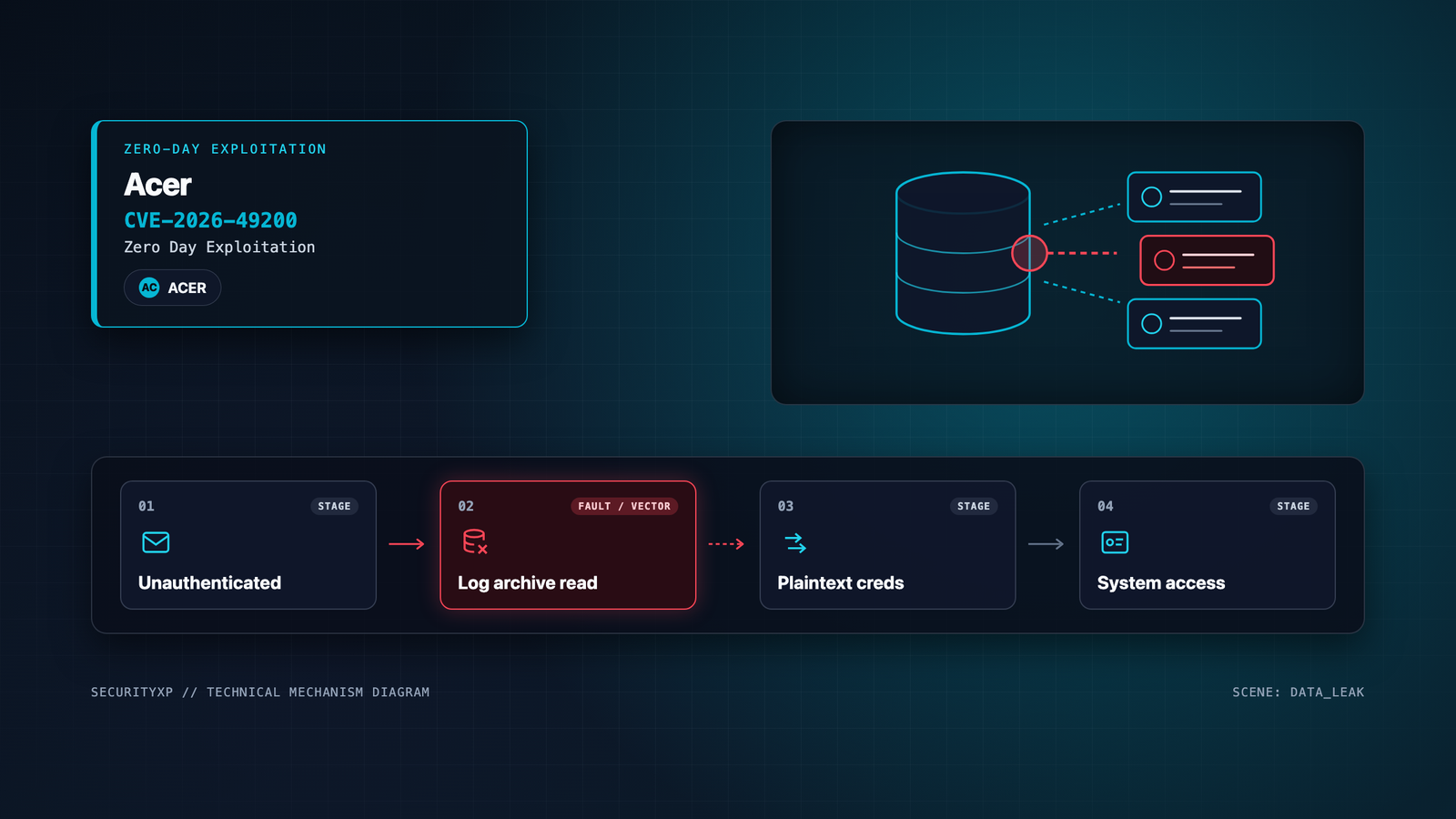
Acer Addresses Zero-Day in Wave 7 Routers
The vulnerability allows unauthenticated attackers to access sensitive credentials from log archives. It's a broken access control flaw, which enables attackers to obtain plaintext credentials.
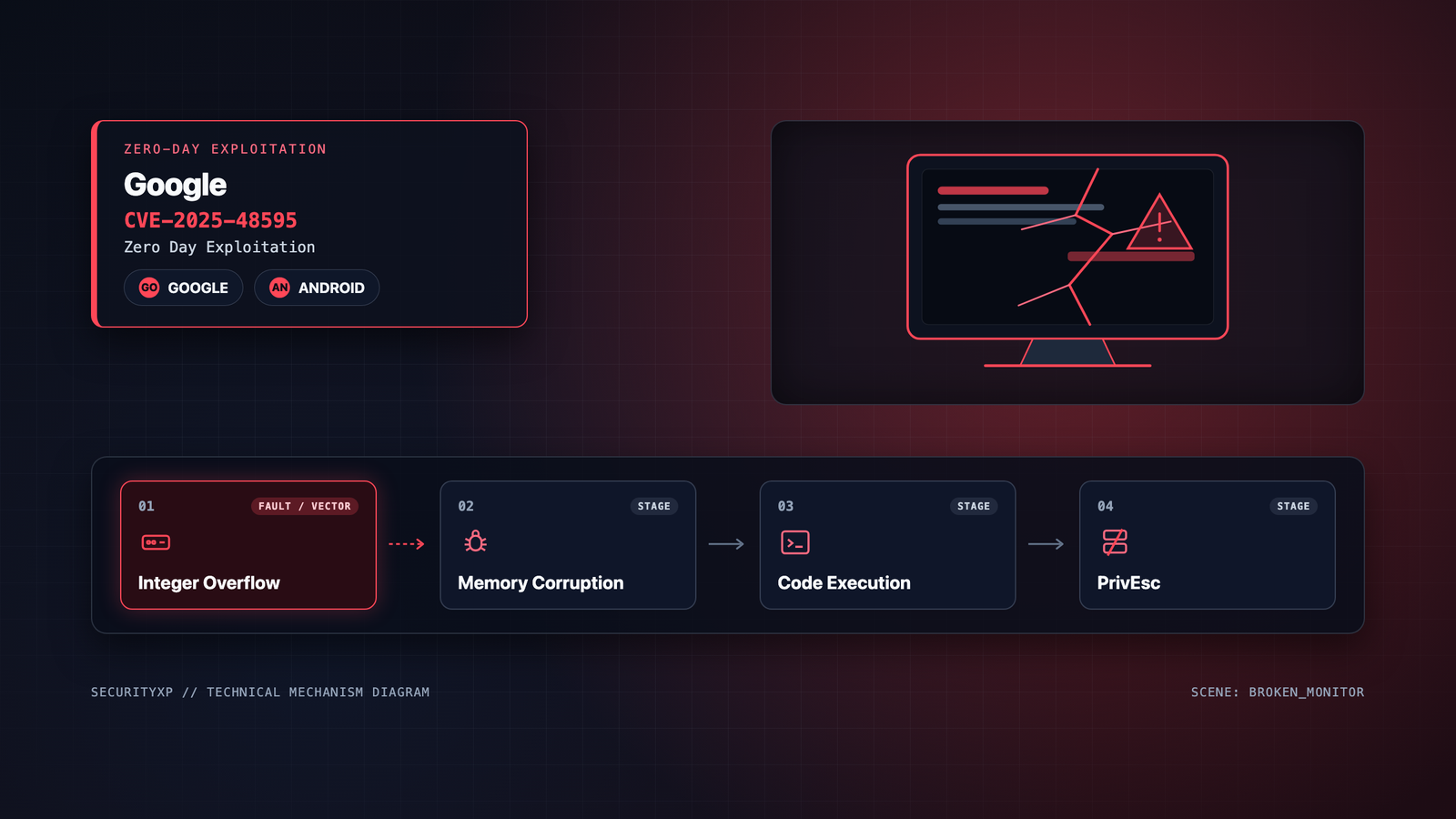
Google Patches Android Zero-Day CVE-2025-48595
One flaw, CVE-2025-48595, is particularly alarming. This vulnerability has a CVSS score of 8.4.