
November 2026 Updates Addressed CVE-2026-112732, but Security Updates Omitted It
Key Facts
- CVE-2026-112732 was addressed by updates released in November 2026.
- CVE-2026-112732 was inadvertently omitted from the November 2026 Security Updates.
- The patch release and the disclosure omission are separate parts of the record.
A release and a disclosure record
CVE-2026-112732 was addressed by updates released in November 2026. The CVE was nevertheless omitted from the November 2026 Security Updates. The omission was inadvertent.
Those facts describe two separate records. The updates released in November 2026 contain the fix. The November 2026 Security Updates do not list the CVE. A release can therefore have addressed a vulnerability without the monthly disclosure record naming it. In this case, that is what happened.
The word “quietly” fits the gap between those records, but it should not be taken to mean that no patch was released. The fix was included in the November 2026 updates. What was missing was the CVE’s entry in the November 2026 Security Updates.
Keeping those points apart prevents a common error. A missing CVE entry is not the same as an unaddressed vulnerability. Here, the available facts establish the first and rule out the second.
What the omission does, and does not, show
The omission matters because it separates patch status from disclosure status. For CVE-2026-112732, patch status is settled by the statement that November 2026 updates addressed it. Disclosure status is settled by its absence from the November 2026 Security Updates.
The stated explanation is limited: the CVE was inadvertently omitted. The supplied material does not give a more detailed account of how that omission occurred. It would be wrong to add a cause, assign responsibility, or suggest a deliberate decision without evidence.
The omission also does not show that no public reference to CVE-2026-112732 exists. It shows that the CVE was left out of a specific November 2026 publication. The source list includes a reference for CVE-2026-112732 and a NIST National Vulnerability Database entry, so references to the identifier exist. That is different from saying the monthly Security Updates included it.
This distinction matters to anyone reconstructing the timeline. The relevant sequence is straightforward: updates released in November 2026 addressed CVE-2026-112732, and the CVE was inadvertently omitted from the November 2026 Security Updates. There is no basis here for moving the fix to another month or treating the documentation omission as a second vulnerability.
Where the available evidence stops
The fact sheet is narrow. It does not identify an affected product, vendor, or version. It does not describe an attack path, a technical mechanism, or exploitation activity. It supplies no detailed remediation or hunting instructions beyond the statement that the November 2026 updates addressed CVE-2026-112732.
The source list does not fill those gaps in the material provided for this article. It gives two links, but it does not reproduce their technical contents. The analysis can cite those references without claiming that they establish details absent from the supplied record.
The absence of product and exploitation details matters. The supplied material does not explain a severity score, affected systems, exploitation difficulty, or prerequisites. Those details should remain unspecified unless a source supports them. The same applies to claims about who was targeted or how an attacker might have gained access.
For readers, the result is a focused account rather than a technical advisory. It establishes that a fix was released and that the corresponding monthly disclosure was incomplete. It does not tell an administrator which package to install, which version boundary matters, or what signs to hunt for.
An analysis can still be useful with those limits. Clarity begins by saying exactly what is known, then marking what is not. In this case, the fix-and-omission record is firm; the surrounding technical picture is not supplied.
Reading the references without overreaching
Two references are provided for CVE-2026-112732:
Their presence gives readers a path to the identifier’s reference pages. It does not expand the confirmed facts in the fact sheet. The first link is labeled as a source referenced in coverage. The second is identified as the NIST National Vulnerability Database entry. Neither label should be used to imply additional findings that have not been supplied.
The distinction between a citation and a conclusion is worth preserving. A source list shows where more information may be found. An article’s conclusions must still be tied to what the supplied material actually says. Here, that material says that November 2026 updates addressed CVE-2026-112732 and that its inclusion in the November 2026 Security Updates was missed.
The bottom line
The November 2026 record should be read in two layers. The update layer contains a fix for CVE-2026-112732. The disclosure layer contains an inadvertent omission from the November 2026 Security Updates.
Neither layer cancels the other. The omission does not negate the fix, and the fix does not make the omission disappear. Any account that presents only one of those facts would give readers an incomplete picture.
The defensible conclusion is narrow and clear: CVE-2026-112732 was addressed by updates released in November 2026, while the CVE was inadvertently omitted from the November 2026 Security Updates. Claims beyond that conclusion need evidence the supplied record does not provide.
Sources & References
- Source referenced in coverage https://msrc.microsoft.com/update-guide/vulnerability/CVE-2026-112732
- CVE-2026-112732 — NIST National Vulnerability Database entry. https://nvd.nist.gov/vuln/detail/CVE-2026-112732
- CVE-2026-112732 — National Vulnerability Database

SecurityXP delivers cybersecurity news, vulnerability analysis, data breach reports, and threat intelligence.
Security Digest
The most important cybersecurity stories, CVE alerts, and threat intelligence — one concise email. Unsubscribe anytime.
Related Articles
VMware vCenter Authentication Bypass Exploited as Zero-Day for Over Two Months Before Patch
Broadcom's VMSA-2026-0009 fixes CVE-2026-123890, a vCenter authentication bypass exploited as a zero-day. Affected versions, fixed builds and hunting guidance.
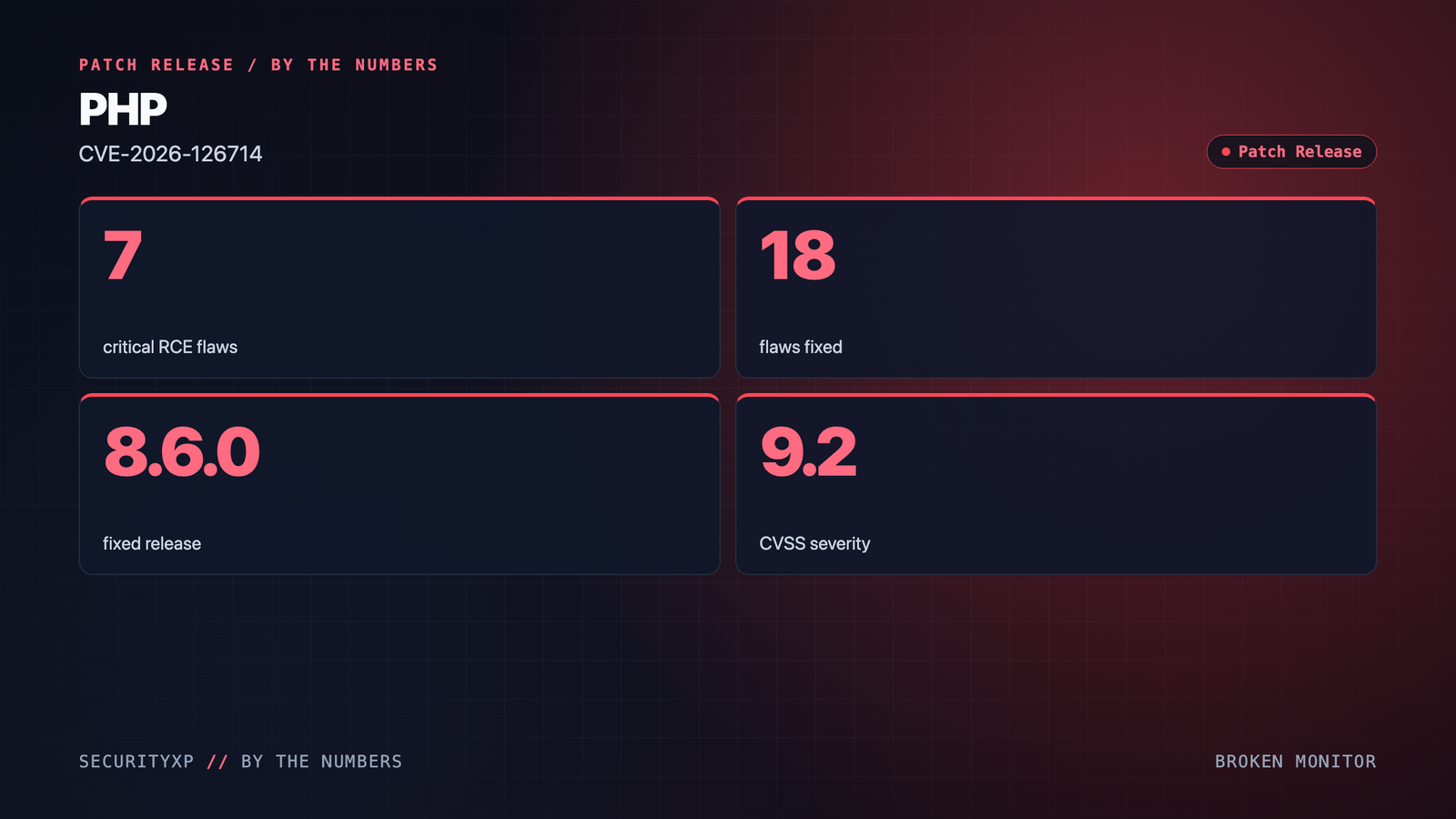
PHP 8.6.0 Carries the Fix for CVE-2026-126714, the 9.2-Rated Flaw October's Releases Left Open
PHP 8.6.0, released today, includes the fix for CVE-2026-126714, a flaw that PHP's maintainers rate 9.2 out of 10 on the CVSS 4.0 scale.
Apache Roller Widens Actively Exploited RCE Flaw to Versions 4.0.0–6.1.4
Apache Roller is an open-source, Java-based blogging platform.
NGINX2Root: Five Critical NGINX RCE Flaws and the Limits of the Public Exploit Record
On November 18, F5 released an out-of-band security update covering 10 vulnerabilities in NGINX Plus and NGINX Open Source.