
Cold Relic Reused Stolen Google Workspace Data to Breach a Second U.S. Organization
Key Facts
- Google's Mandiant and GTIG investigated a 2026 compromise at a U.S.-based organization that used data and identities from a late-2025 attack on another U.S.-based entity.
- Cold Relic accessed the Admin Console, queried security investigation and email audit logs, and viewed, modified, and deleted Alert Center notifications, according to Google.
- Using Super Admin privileges, the actor exported full employee lists and domain-wide data via Google Takeout.
- Google said Cold Relic uses stolen emails and data to establish authentic pretexts and impersonate contacts when reaching out to subsequent targets.
- Google's account includes a quoted assessment linking the activity to Russian intelligence services and the use of personnel rosters and operational documents.
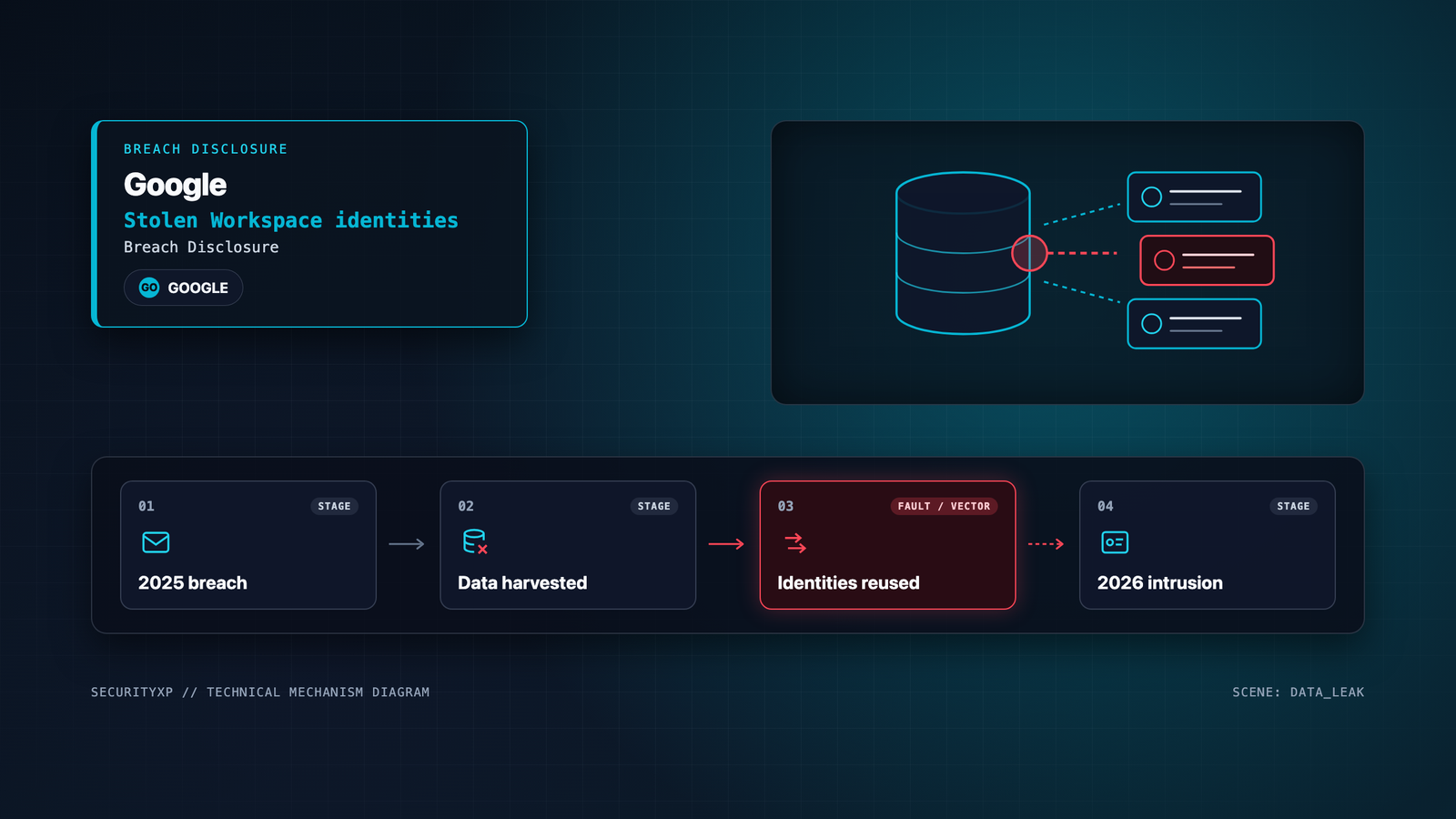
Google’s Mandiant and Threat Intelligence Group (GTIG) said it investigated a 2026 compromise at a U.S.-based organization in which the adversary leveraged data, the corporate staff directory, and identities harvested from an earlier attack on another U.S.-based entity in late 2025. The case is the subject of Google’s advisory, “COLD RELIC: A Case Study in Impersonation and Compromise.”
According to the tech giant’s cybersecurity and incident response teams, Cold Relic compromised the cloud productivity environment of an unspecified U.S.-based organization in late 2025. The 2026 compromise described by Mandiant and GTIG involved a different U.S.-based organization. Google’s account therefore covers two events: an earlier intrusion whose data and identities were retained, and a later intrusion in which those materials were used.
Inside the tenant
Google’s most specific finding concerns what Cold Relic did after reaching the second organization’s environment. The company said: “While operating inside the tenant of the victim organization, Cold Relic accessed the Admin Console, queried Admin security investigation and email audit logs to check defensive visibility, and viewed, modified, and deleted Alert Center notifications to remove forensic evidence of the initial intrusion.”
That passage places the actor inside administrative interfaces, not only inside a user’s mailbox. The actor queried security investigation logs and email audit logs, according to Google, to check what defenders could see. It then viewed, modified, and deleted Alert Center notifications, the company said, with the stated aim of removing forensic evidence of the initial intrusion. The same passage says these actions ultimately enabled the threat actor to export full employee lists and domain-wide data via the Google Takeout service using the Super Admin privileges.
Google’s wording matters. The export is described as the outcome of administrative access. The employee lists and domain-wide data are described as the objects of the theft. The Super Admin privileges are described as the mechanism. Google’s account does not say how those privileges were obtained, how long they were held, or which specific files or records were exported.
The value of a staff directory
The earlier intrusion supplied more than credentials, according to Google. It supplied data, the corporate staff directory, and identities. Those materials became inputs for the later operation. Google said: “Once Cold Relic compromises a target, it uses stolen emails and data to establish authentic pretexts and impersonate contacts when reaching out to subsequent targets.”
That sentence explains why a staff directory can be operational rather than merely administrative. A directory maps roles, relationships, and contact paths. Stolen emails and data can supply the context that makes an approach look routine. Google’s account does not describe the specific pretexts used in the 2026 case, but it does describe the pattern: data from one compromise is reused to reach another target.
Google also included a statement about Russian intelligence services: “By obtaining access to strategic personnel rosters and operational documents, Russian intelligence services turn legitimate business communications into attack vectors against trusted partners.” The quote frames the theft of personnel and operational material as a way to borrow trust from legitimate communications.
What the case emphasizes
The disclosed sequence puts cloud identity and administrative visibility at the center of the intrusion. Cold Relic is said to have accessed the Admin Console, checked whether its activity was visible, altered notifications, and used Super Admin rights to export data through Takeout. Each step sits inside the productivity environment that the victim organization relied on. Google’s account does not describe endpoint malware, network exploitation, or a separate command-and-control channel, and this account should not be read as claiming those details.
The sequence also shows why the first breach cannot be treated as closed when the first organization’s data is stolen. Google says the 2026 compromise used data, a staff directory, and identities from the late-2025 attack. In that framing, the earlier theft became staging material for the later intrusion. Google does not say whether the two organizations were partners, customers, or otherwise connected, and it does not name either victim.
What remains undisclosed
Google’s account leaves several questions open. It does not specify how Cold Relic gained initial access to either organization, how many employee records were exported, what categories of domain-wide data were taken through Takeout, or whether the second organization detected the Admin Console activity before the export. It gives only broad timing: late 2025 for the earlier compromise and 2026 for the later one. It also does not say whether Google notified the affected organizations, whether the activity was remediated, or whether the stolen data has since been used in further targeting.
Those gaps limit what can be concluded. The confirmed elements are the actor’s reported use of harvested data and identities, its access to the Admin Console, its querying of security investigation and email audit logs, its viewing, modification, and deletion of Alert Center notifications, and its use of Super Admin privileges to export employee lists and domain-wide data through Google Takeout.
For readers tracking the campaign, the key point is continuity between incidents. The 2026 compromise is not described as a standalone phishing success. It is described as an operation that drew on material from a prior U.S. victim and then used the second organization’s own administrative systems to widen the theft. Google’s language about authentic pretexts and trusted partners places that continuity at the center of the risk.
Sources & References
- COLD RELIC: A Case Study in Impersonation and Compromise | Google Cloud Blog. Primary vendor advisory. https://cloud.google.com/blog/topics/threat-intelligence/cold-relic-a-case-study-in-impersonation-and-compromise
- The Hacker News report on Google's Cold Relic case study. https://thehackernews.com/2026/11/russian-cold-relic-hackers-use-stolen.html

SecurityXP delivers cybersecurity news, vulnerability analysis, data breach reports, and threat intelligence.
Security Digest
The most important cybersecurity stories, CVE alerts, and threat intelligence — one concise email. Unsubscribe anytime.
Related Articles
Cold Relic Reused Stolen Google Workspace Data to Breach a Second U.S. Organization
Google says Cold Relic reused stolen identities and Workspace data from an earlier breach to compromise a second U.S. organization.
Kodak Confirms Data Breach Following ShinyHunters’ Claim of Stolen Customer Records
One week ago, the extortion group also claimed responsibility for a new series of breaches at over 100 organizations(including the University of Nottingham)...
Google Sues Chinese Cybercrime Network for Using Gemini AI to Target Americans
Google is taking legal action against a Chinese cybercrime network it says abused its Gemini AI agent to send phishing texts and steal data from Americans.
Oracle mitigates PeopleSoft zero-day exploited in data theft attacks
Oracle has issued mitigations for a critical PeopleSoft zero-day (CVE-2026-35273) enabling unauthenticated RCE, actively exploited in ShinyHunters data theft.