
CISA Orders Federal Agencies to Patch Exploited Puppet Enterprise RCE by December 1
Key Facts
- CISA added CVE-2026-115731 to its Known Exploited Vulnerabilities catalog on Tuesday and ordered US federal civilian agencies to address it by December 1, 2026.
- Perforce Software addressed the vulnerability on November 3, 2026, in Puppet Enterprise 2026.0.1, 2025.12.1, and 2023.8.13, and in Puppet Core 9.1.3 and 8.22.2.
- Alain Rödel, a security researcher at Neodyme AG, is credited with discovering and reporting CVE-2026-115731 along with CVE-2026-115732 (CVSS score: 9.0), a critical certificate-name authorization bypass affecting both Puppet and OpenVox.
- OpenVox is also affected; fixes ship in OpenVox Agent 9.3.0 and 8.32.0 and OpenVox Server 9.2.0 and 8.18.0.
- Perforce has stated that it is not aware of attacks exploiting the flaw and has found no evidence of customer data being accessed; details of the in-the-wild attacks have yet to be made public.
CISA lists the flaw as exploited, and sets a deadline
On Tuesday, the US Cybersecurity and Infrastructure Security Agency added CVE-2026-115731 to its Known Exploited Vulnerabilities catalog. The entry came with a deadline attached: US federal civilian agencies must address the flaw by December 1, 2026.
The catalog is not a list of interesting bugs. It is a record of vulnerabilities that attackers have used, and the deadlines that follow from it are issued under Binding Operational Directive 22-01, the standing order that governs how federal civilian agencies remediate the flaws on it. An entry moves a CVE from “this should be patched” to “this must be patched, by this date.”
For people who do not work for a federal civilian agency, the deadline is still a useful signal. A vulnerability that the US government treats as actively exploited, and expects to be closed within weeks, is one worth closing wherever the software runs. Puppet Enterprise is the commercial product; OpenVox is an open-source implementation of Puppet. Both are covered by this advisory cycle, and both have fixes available.
The weak point is the certificate authority
Perforce Software fixed the vulnerability on November 3, 2026. The description of the shortcoming, as given in the advisory material, is short and specific:
“If the certificate authority automatically signs requests without strong verification, an unauthenticated network attacker can obtain a valid certificate and exploit the vulnerability.”
That sentence describes a familiar shape of failure. A certificate authority exists to decide which machines are allowed to join a system. When it signs requests automatically, without verifying them properly, that decision is no longer being made. An attacker who can reach the service and ask for a certificate receives one, and a valid certificate is the credential the rest of the system is built to trust. The result is remote code execution, reachable by someone who never held credentials of their own.
The flaw was found and reported by Alain Rödel, a security researcher at Neodyme AG. He is credited with CVE-2026-115731 and, along with it, CVE-2026-115732 (CVSS score: 9.0), a critical certificate-name authorization bypass affecting both Puppet and OpenVox. Both identifiers have entries in NIST’s National Vulnerability Database, on Red Hat’s CVE portal, and in GitHub’s advisory database. Neodyme published its own account of the research under the title “Pulling the right strings for RCE on a Puppet.”
The versions affected, and the versions that fix them
The shortcoming impacts the following versions:
- Puppet Enterprise 2026.0.0 before 2026.0.1
- Puppet Enterprise 2025.0.0 before 2025.12.1
- Puppet Enterprise 2023.8.0 before 2023.8.13
- Puppet Core 9.0.0 before 9.1.3
- Puppet Core 8.x before 8.22.2
It was addressed by Perforce Software on November 3, 2026, in the following versions:
- Puppet Enterprise 2026.0.1 (Puppet Core 9.1.3)
- Puppet Enterprise 2025.12.1 (Puppet Core 8.22.2)
- Puppet Enterprise 2023.8.13 (Puppet Core 8.22.2)
- Puppet Core 9.1.3
- Puppet Core 8.22.2
It is worth noting that the issue also affects OpenVox, an open-source implementation of Puppet, and has been resolved in the following versions:
- OpenVox Agent 9.3.0 and 8.32.0
- OpenVox Server 9.2.0 and 8.18.0
The two lists are worth reading together. A reader who upgrades Puppet Enterprise but leaves an OpenVox installation untouched has closed one door and left another open, and the version strings on the second list do not resemble the first.
What is not yet public
Details about the in-the-wild attacks have yet to be made public. As of writing, there are no details on how the vulnerability is being weaponized in the wild.
Perforce has stated that it is not aware of attacks exploiting the flaw and has found no evidence of customer data being accessed. A catalog entry reflects what CISA has observed; a vendor statement reflects what the vendor has observed. Both can be accurate at the same time, and neither tells an administrator what is happening on their own network.
That gap is where the decision has to be made. Remote code execution on such a central and important system can lead to worst-case scenarios: deployment of ransomware, mass data exfiltration, and potentially lateral movement to other parts of the network. None of the worst cases require an attacker to be clever once a trusted certificate is in hand.
The fix has existed since November 3, 2026. The federal civilian deadline lands four weeks later, on December 1, 2026. For everyone else, the useful date is the one printed next to the version number on the installed system, compared against the lists above.
Sources & References
- Primary source (government_alert) referenced by Security Affairs https://cyber.dhs.gov/bod/22-01/
- CVE-2026-115731 - Red Hat Customer Portal. Primary vendor advisory. https://access.redhat.com/security/cve/cve-2026-115731
- Pulling the right strings for RCE on a Puppet — Neodyme. Primary research blog. https://neodyme.io/en/blog/puppet_rce/
- Authenticated RCE on OpenVox server via Event Deserialization · Advisory · OpenVoxProject/openvox · GitHub. Primary github release. https://github.com/OpenVoxProject/openvox/security/advisories/GHSA-ffr6-rwpm-p5wq
- Flawed Hostname Check allows Puppet Client Impersonation · Advisory · OpenVoxProject/trapperkeeper-authorization · GitHub. Primary github release. https://github.com/OpenVoxProject/trapperkeeper-authorization/security/advisories/GHSA-q4hm-33rc-572g
- CVE-2026-115731 — National Vulnerability Database
- CVE-2026-115732 — National Vulnerability Database

SecurityXP delivers cybersecurity news, vulnerability analysis, data breach reports, and threat intelligence.
Security Digest
The most important cybersecurity stories, CVE alerts, and threat intelligence — one concise email. Unsubscribe anytime.
Related Articles
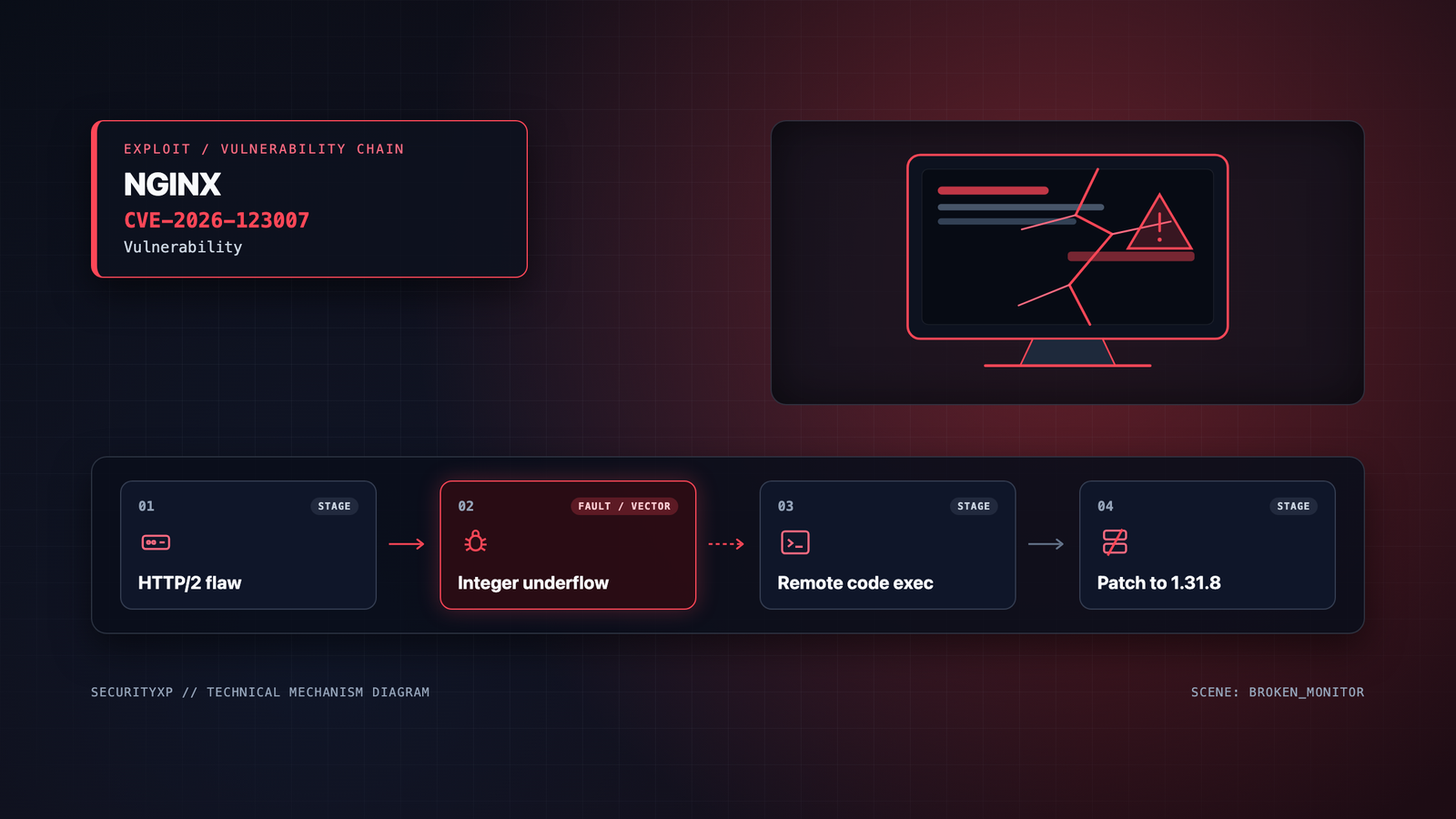
NGINX2Root: Five Critical NGINX RCE Flaws and the Limits of the Public Exploit Record
On November 18, F5 released an out-of-band security update covering 10 vulnerabilities in NGINX Plus and NGINX Open Source.
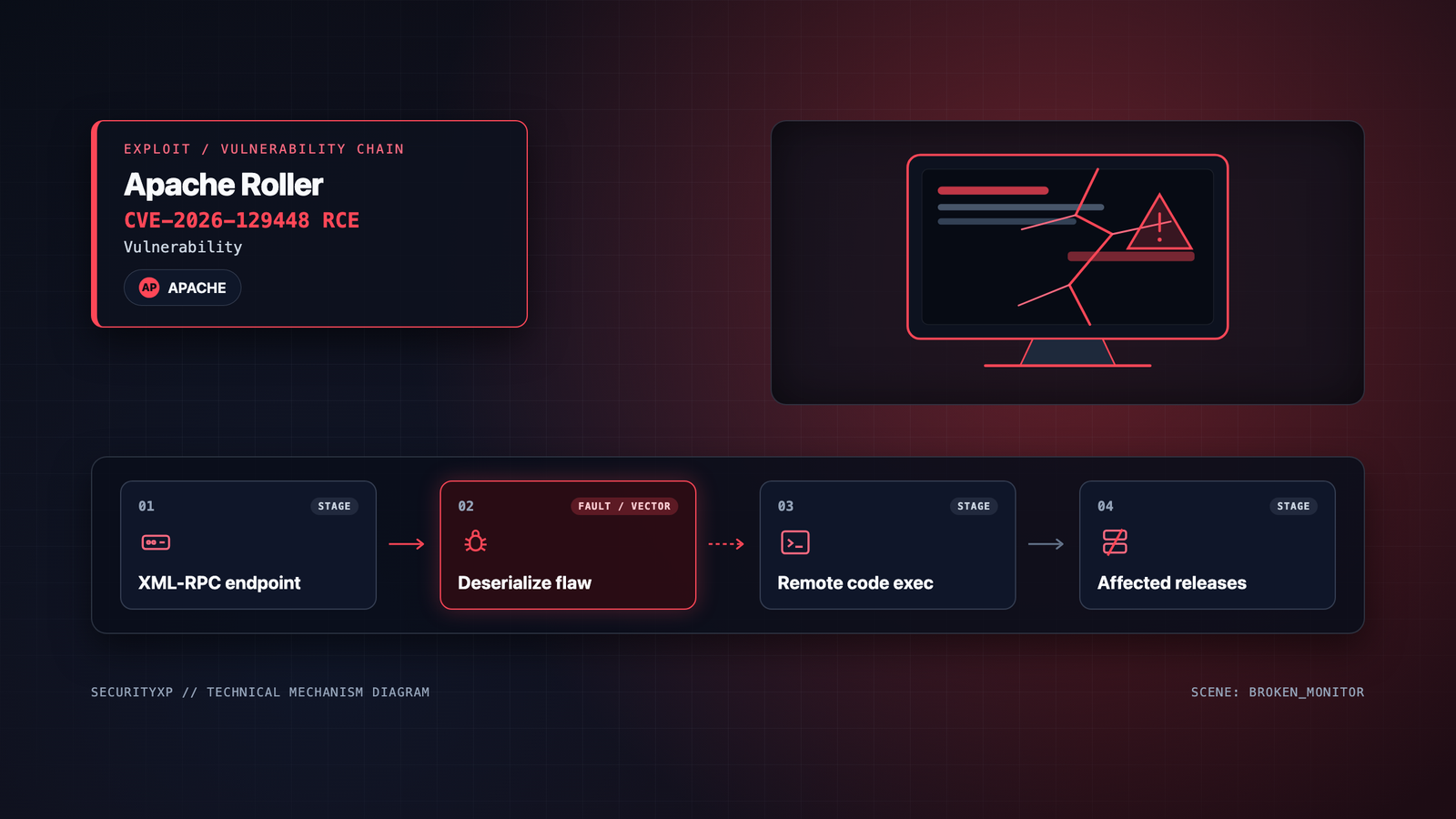
Apache Roller Widens Actively Exploited RCE Flaw to Versions 4.0.0–6.1.4
Apache Roller is an open-source, Java-based blogging platform.
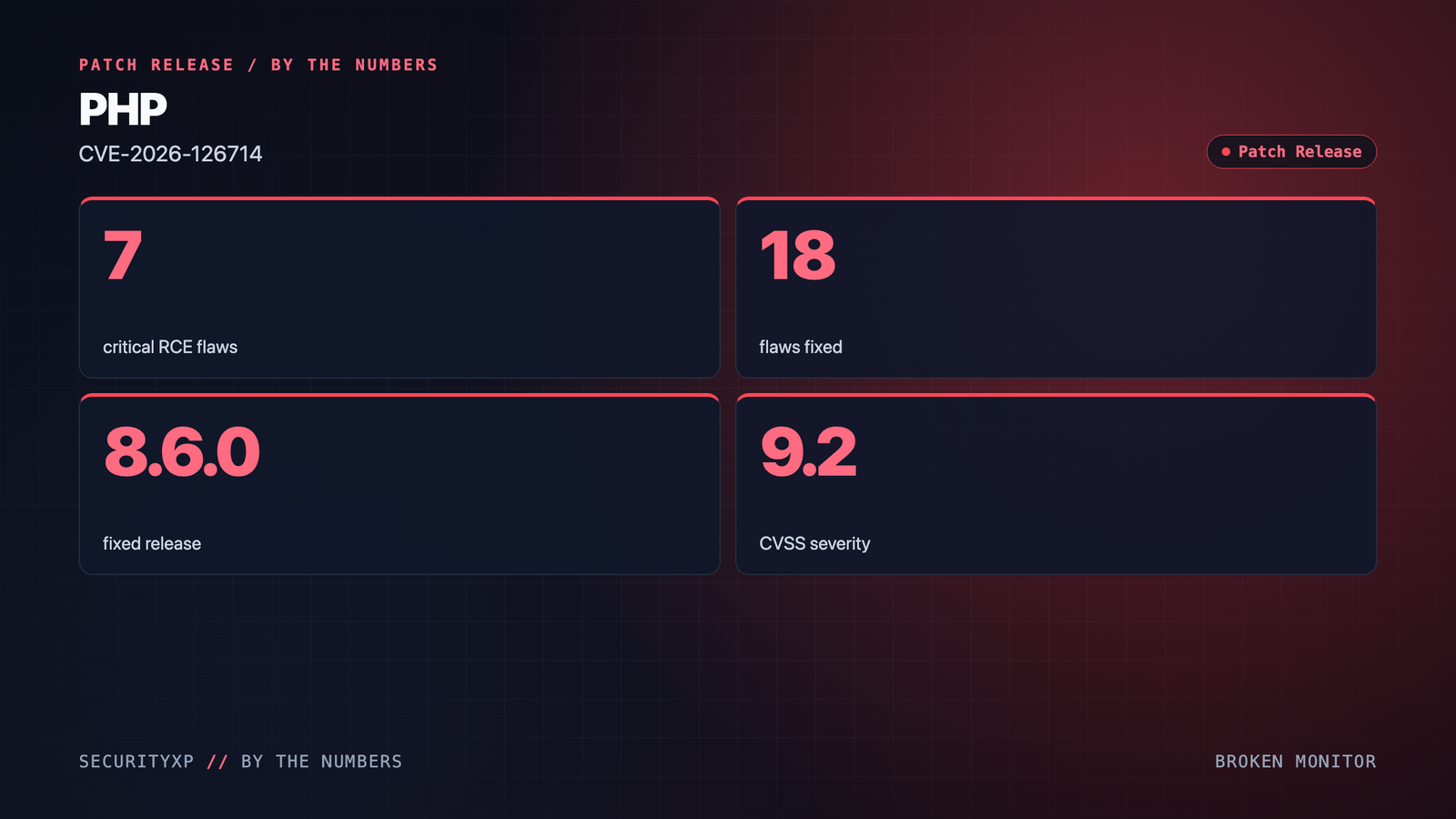
PHP 8.6.0 Carries the Fix for CVE-2026-126714, the 9.2-Rated Flaw October's Releases Left Open
PHP 8.6.0, released today, includes the fix for CVE-2026-126714, a flaw that PHP's maintainers rate 9.2 out of 10 on the CVSS 4.0 scale.
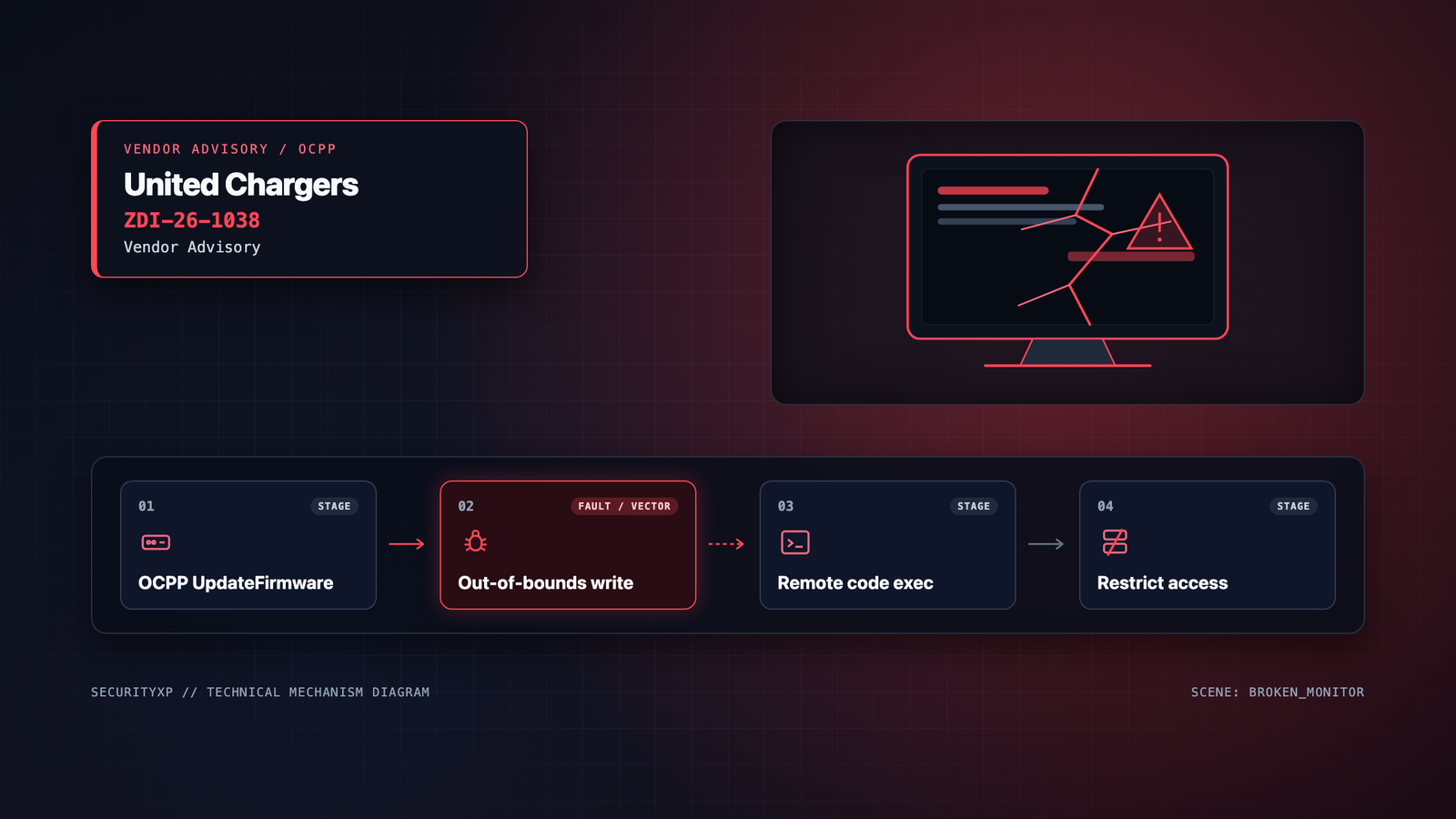
Grizzl-E Smart 40A Charger Flaw Lets a Nearby, Unauthenticated Attacker Run Code
The Zero Day Initiative's advisory on the United Chargers Grizzl-E Smart 40A EV charger is short, and one sentence carries the weight: the vulnerability…